The <slide> element
Parent element: <notations>
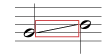
The <glissando> and <slide> elements both indicate rapidly moving from one pitch to the other so that individual notes are not discerned. A <slide> is continuous between the two pitches and defaults to a solid line. The optional text is printed alongside the line.
Content
xs:stringAttributes
| Name | Type | Required?(Default) | Description |
|---|---|---|---|
| type | start-stop | Yes | Indicates if this is the start or stop of the slide. |
| Indicates if this is the start or stop of the slide. | |||
| accelerate | yes-no | No | Does the bend accelerate during playback? Default is “no”. |
| Does the bend accelerate during playback? Default is “no”. | |||
| beats | trill-beats | No | The number of discrete elements (like MIDI pitch bends) used to represent a continuous bend or slide. Default is 4. |
| The number of discrete elements (like MIDI pitch bends) used to represent a continuous bend or slide. Default is 4. | |||
| color | color | No | Indicates the color of an element. |
| Indicates the color of an element. | |||
| dash-length | tenths | No | The length of dashes in a dashed line. Ignored if the corresponding line-type attribute is not dashed. |
| The length of dashes in a dashed line. Ignored if the corresponding line-type attribute is not dashed. | |||
| default-x | tenths | No | Changes the computation of the default horizontal position. The origin is changed relative to the left-hand side of the note or the musical position within the bar. Positive x is right and negative x is left.
This attribute provides higher-resolution positioning data than the |
| Changes the computation of the default horizontal position. The origin is changed relative to the left-hand side of the note or the musical position within the bar. Positive x is right and negative x is left.
This attribute provides higher-resolution positioning data than the | |||
| default-y | tenths | No | Changes the computation of the default vertical position. The origin is changed relative to the top line of the staff. Positive y is up and negative y is down.
This attribute provides higher-resolution positioning data than the placement attribute. Applications reading a MusicXML file that can understand both attributes should generally rely on this attribute for its greater accuracy. |
| Changes the computation of the default vertical position. The origin is changed relative to the top line of the staff. Positive y is up and negative y is down.
This attribute provides higher-resolution positioning data than the placement attribute. Applications reading a MusicXML file that can understand both attributes should generally rely on this attribute for its greater accuracy. | |||
| first-beat | percent | No | The percentage of the duration for starting a bend. Default is 25. |
| The percentage of the duration for starting a bend. Default is 25. | |||
| font-family | font-family | No | A comma-separated list of font names. |
| A comma-separated list of font names. | |||
| font-size | font-size | No | One of the CSS sizes or a numeric point size. |
| One of the CSS sizes or a numeric point size. | |||
| font-style | font-style | No | Normal or italic style. |
| Normal or italic style. | |||
| font-weight | font-weight | No | Normal or bold weight. |
| Normal or bold weight. | |||
| id | xs:ID | No | Specifies an ID that is unique to the entire document. |
| Specifies an ID that is unique to the entire document. | |||
| last-beat | percent | No | The percentage of the duration for ending a bend. Default is 75. |
| The percentage of the duration for ending a bend. Default is 75. | |||
| line-type | line-type | No | Specifies if the line is solid, dashed, dotted, or wavy. |
| Specifies if the line is solid, dashed, dotted, or wavy. | |||
| number | number-level | No (1) | Distinguishes multiple slides when they overlap in MusicXML document order. The default value is 1. |
| Distinguishes multiple slides when they overlap in MusicXML document order. The default value is 1. | |||
| relative-x | tenths | No | Changes the horizontal position relative to the default position, either as computed by the individual program, or as overridden by the default-x attribute. Positive x is right and negative x is left. It should be interpreted in the context of the <offset> element or directive attribute if those are present. |
Changes the horizontal position relative to the default position, either as computed by the individual program, or as overridden by the default-x attribute. Positive x is right and negative x is left. It should be interpreted in the context of the <offset> element or directive attribute if those are present. | |||
| relative-y | tenths | No | Changes the vertical position relative to the default position, either as computed by the individual program, or as overridden by the default-y attribute. Positive y is up and negative y is down. It should be interpreted in the context of the placement attribute if that is present. |
| Changes the vertical position relative to the default position, either as computed by the individual program, or as overridden by the default-y attribute. Positive y is up and negative y is down. It should be interpreted in the context of the placement attribute if that is present. | |||
| space-length | tenths | No | The length of spaces in a dashed line. Ignored if the corresponding line-type attribute is not dashed. |
| The length of spaces in a dashed line. Ignored if the corresponding line-type attribute is not dashed. | |||
Examples
This element is used in the following example: